Is Plug-In Solar Safe?
This blog post contains affiliate links. As an Amazon Associate I earn from qualifying purchases.
Plug-in solar (also called plug-in photovoltaic or PIPV for short) systems are safe as long as the right products are chosen and they are installed correctly. Over one million systems have been installed in Germany without any major issues occurring. However, working with electricity is inherently dangerous and the plug-in solar market is still developing in the US. The US electrical systems in our homes are also different than Germany’s, so we have some unique safety considerations that they don’t. With this article I have done my best to explain the risks of plug-in solar, but I am not an electrician. If you still have doubts that you can install plug-in solar safely then it may not be for you, or you may want to hire an electrician if it is not cost prohibitive.
Plug-In Solar Safety Risks and How to Mitigate Them
Line Worker Electrical Injury
It is critical to protect line workers from electrical injuries and death from plug-in solar. When there is a power outage, if a plug-in solar system is sending power to the grid, it could kill a line worker. Fortunately there is a standard called UL 1741 for inverters. As long as you buy an inverter that has a UL 1741 certification, there is virtually zero risk that your device will injure a line worker. See the SACE whitepaper for details. This also means that your system will not provide you power during an outage. I’ll be writing more about how to use portable batteries with plug-in solar in the future.
Breaker Masking
Breaker masking is the most common issue that someone buying plug-in solar should know about. Normally your breaker will trip if too much electricity is flowing through your circuit to prevent your wires from overheating and starting a fire. With plug-in solar the breaker cannot detect the total electrical current that is flowing through the circuit. It just knows about the current that is coming from the grid, not the current that is being fed onto the circuit from plug-in solar. This only occurs if the inverter is between the breaker and the loads. While an outdoor socket is more likely to be at the end of a circuit, most people won’t be able to confirm this without an electrician, so it is safer not to assume.
Most sources agree that below around 420W the risk of breaker masking is reduced to a tolerable level. That number comes from a 2025 paper in Energies by researchers at Berkeley Lab, GismoPower and Impulse Labs, which works it out from the spare overload capacity a typical circuit already has.
Some states have a threshold near that number. Colorado exempts a device at or below 391W from its solar installation requirements and from the building code and product listing rules that would mean changing your wiring. Maryland’s 391W threshold exempts a system from UL listing provisions that would otherwise require altering your premises, wiring, or panel. Maine has the one state threshold that lines up with the masking number: at or below 420W you can install the system yourself, and above that a licensed electrician has to do it.
If you don’t want to worry about the breaker masking issue, I’d recommend getting a system at or below your state’s lower threshold (i.e. 391W) if it has one, or below 420W if your state does not have a lower threshold. If you live in an unregulated state (any state that has not passed a plug-in solar law) and are buying/designing a system you can use 420W as the threshold where you need to protect against breaker masking. If you’d like a bigger system you have three options:
- Use a dedicated circuit
- Buy a system with a UL 3141-certified Power Control System
- Buy a system with a panel-installed circuit-monitoring device
At the time of writing I don’t have any products on my site that have breaker masking protection, so they should be used on a dedicated circuit. An example of a product that is designed to prevent breaker masking is Craftstrom’s “NEC Smart Breaker” that is part of their kits.
At the time of writing I have no partnership with Craftstrom. The link to their site above is not an affiliate link.
How Do You Know if You Have a Dedicated Circuit?
A dedicated circuit is a circuit that has only one outlet and no other light fixtures or hardwired appliances on it. You can determine whether or not the outlet you want to use for plug-in solar is on a dedicated circuit by finding the circuit in your breaker box and flipping it off. After you turn off the circuit, ensure that only the outlet you expect to be deenergized is deenergized. You may have to turn off a few circuits to figure out which one is the target circuit if it is not labeled “balcony” or “outdoor” or something like that. For example, when I did this with my apartment, I tried turning off a circuit called “wall plugs” and the lights in my kitchen went out, but I could still see the balcony was energized using my phone charger. I turned that back on, then turned off one called “living room”. The lights in my living room went out and my phone charger did not work with the balcony outlet. So I don’t have a dedicated circuit. When Colorado’s renter protections kick in on January 1st, 2027, I will likely go with a 391W system so I am under the threshold where breaker masking is a risk and under the lower regulatory threshold in Colorado.
Shock Risk From Touching Energized Prongs
With a normal appliance, if you pull the plug out halfway so the prongs are still connected to the outlet and touch the prongs you will get shocked (seriously don’t do that!). But if you were to unplug an appliance completely and touch the prongs, nothing will happen. With plug-in solar, unplugging the system while the sun is still hitting the panels means that you could still get shocked if you touch the prongs after unplugging it. An obvious solution to this is to not unplug the system when it is sunny, or to cover the solar panels completely with a tarp if you need to unplug it during the day. You might expect the UL 1741 certification that protects line workers to help you here as well, but UL says the opposite in as many words: relying on the inverter’s grid connection function to limit shock exposure at the plug blades is not an appropriate solution. The certification allows up to 2 seconds to shut down. In practice anti-islanding disconnection usually takes 100 to 300 milliseconds and can be as quick as 40, but that is still plenty of time to get shocked. The sources disagree here, and Permit Power’s fact sheet flatly answers “no” to whether the prongs will shock users. I’d go with UL’s caution. Don’t unplug the inverter while there is any sunlight, and be extra careful if it is also wet out.
Shock Risk From Not Having GFCI Protection
You should always plug your inverter into an outlet that has GFCI protection. Typically that looks like this:
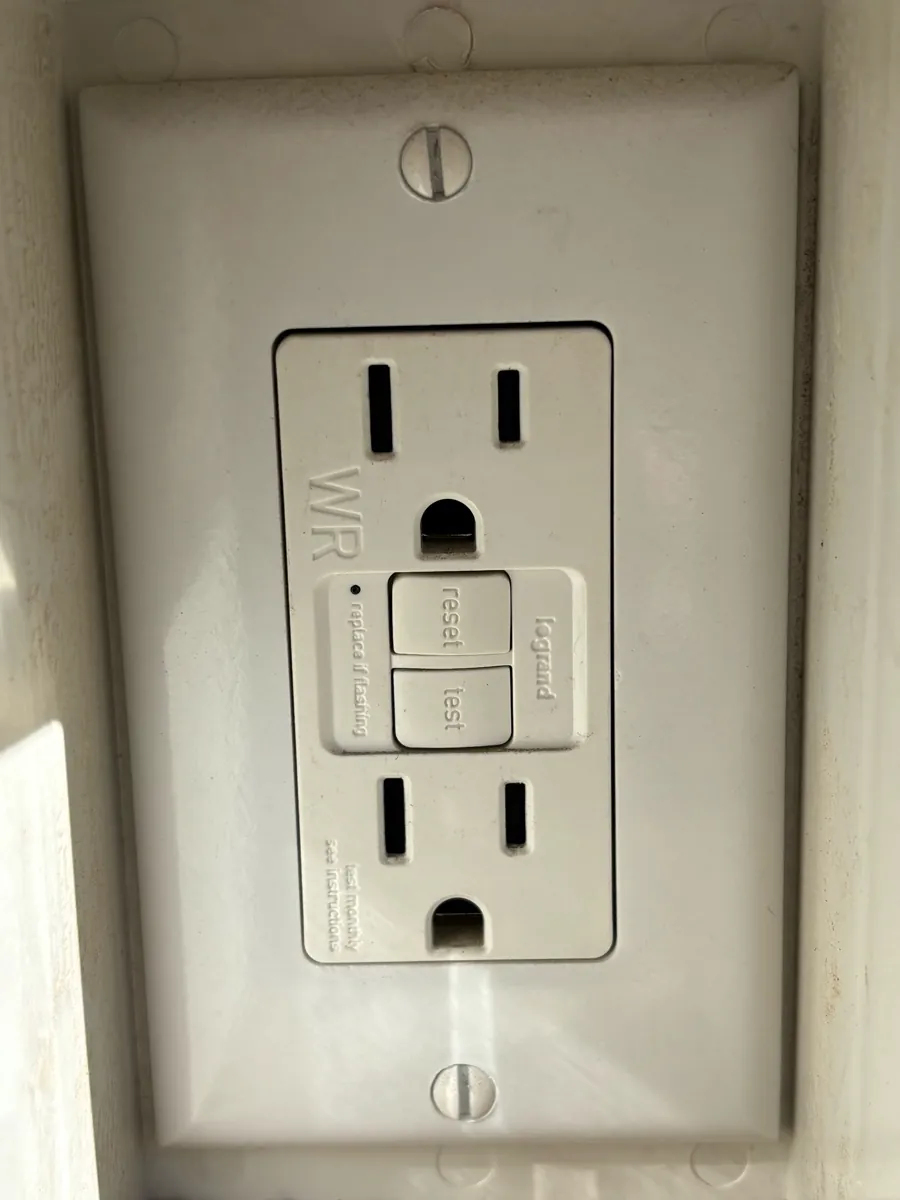
If you do not see a GFCI outlet, it’s possible that the circuit is protected by a GFCI breaker in your panel instead. Here is a video that explains the differences and some more details that are helpful.
A GFCI cuts the power when it detects current leaking to ground, which is the kind of fault that electrocutes people. It does that whether things are wet or dry. The NEC (National Electrical Code) requires GFCIs in places where water makes that fault more likely, which is why you should already have GFCI protection outside, in the kitchen, and in bathrooms.
A lot of sites will tell you that you need a GFCI outlet specifically. That is overstated, but it is not wrong either. UL tested both kinds with plug-in solar on the circuit, and the outlet passed where the breaker did not. A GFCI breaker still catches the fault and still protects you, and it is a long way better than nothing, so I would not let it stop you from installing. You are accepting one narrow risk that an outlet would have closed, and the next section spells out what it is.
The case to worry about is having neither. If you live in an older house and your outdoor outlet has no GFCI protection at all, your best bet is to hire an electrician to install some. That increases the cost and payback period of your system, so it may not be worth installing plug-in solar if that is where you are starting from. If you are paying an electrician anyway, ask for a GFCI outlet where you plug in rather than a GFCI breaker in the panel. The cost is about the same and the protection is better, for the reason in the next section.
Shock Risk from a Blinded GFCI Circuit
This one gets more technical, but stick with me, because it changes which kind of GFCI protection you want.
Say there is a frayed cord somewhere else on the same circuit and you touch it. The GFCI sees the fault and cuts the power in a fraction of a second. That part still works fine with plug-in solar. The problem is what happens next. Your inverter is plugged in downstream of the GFCI, so tripping it does not turn the inverter off. It keeps feeding power into the circuit, and into you, until it notices the grid is gone and shuts itself down. The rules give inverters up to two seconds to do that. UL tested this, and the shock lasted 33 to 37 milliseconds, compared to 12.6 milliseconds with no solar on the circuit. The safety limit is 28.6 milliseconds. The inverter they tested shut down much faster than it was required to, so a slower one would be worse. UL calls this “blinding” the GFCI.
Here is the part that matters for you. UL ran the same test with a GFCI outlet instead of a GFCI breaker and it passed. A GFCI breaker in your panel only cuts the hot wire and leaves the neutral connected, which is what gives the inverter a path to keep pushing current. A GFCI outlet cuts both wires, so the inverter loses that path and stops. If you are having an electrician install protection, ask for a GFCI outlet where you plug in rather than a GFCI breaker in the panel.
Two caveats. Ordinary appliances have internal filter parts that can partially rebuild that path, so an outlet is better but not a guarantee. And because your inverter uses a standard plug, a GFCI outlet only protects you at the outlet it is actually plugged into. Move your panel to a different outlet and you are back to whatever that circuit has.
None of this makes a GFCI breaker worthless. It still catches the fault and trips, and it is far better than no GFCI protection at all. The gap only opens if a ground fault happens on that circuit while the panels are producing.
Shock Risk From Damaged GFCI Outlets
Backfeeding a GFCI has been reported to damage some of them, leaving them energized but no longer protecting the circuit. The research here is preliminary. It comes from one set of informal tests where a few samples were damaged, and there are no other reports either way. What makes it plausible is that UL 943, the standard GFCIs are certified to, only evaluates current flowing from the line side to the load side. That is why they are marked “line” and “load”. Pushing power back through one is outside what was tested. If you are using plug-in solar you should periodically test your outlet to ensure the GFCI protection is still working. You can use something like this to test your outlet.
Mounting Risks
Solar panels can also become dangerous if they are blown around in the wind, or if the mounting were to break under the weight of heavy snow. If you are putting your solar panels in your yard I recommend a heavy-duty ground mount frame like the IntegraRack IR-30 Ground Mount Frame. It’s expensive, but you want to be able to leave this outside in the sun year-round without it blowing into a person or car on the windiest day of the year.
Despite plug-in solar originally being known as “balcony solar”, in Germany it has been a lot more common for people to install plug-in solar in their yard for a home they own vs on an apartment balcony. If you live in an apartment like me, take extra care to install plug-in solar safely so that it will not hurt someone if it falls. At the time of writing the products section of my site does not have solar panels or mounting systems that are suitable for mounting on apartment railings. I’ll be working on adding those in the future. Until then, search for “lightweight flexible solar panels” on Amazon. These are typically used for RVs and boats, and weigh a few pounds for a 100W panel. One caveat with these panels is that they are reported to be less reliable than standard panels. The payoff calculator on my site estimates a 25-year lifetime for the panels. Expect a shorter lifetime on flexible panels.
Hitting a Buried Utility Line
If you are putting a ground mount in your yard, contact 811 a few days before you start. 811 is the free national “call before you dig” number. Your call (or an online request, which works too) goes to your state’s 811 center, which tells the utilities with lines near you. They send someone out to mark the approximate location of their buried gas, electric, water, and communication lines with paint or small flags. Then you place your mount away from the marks. The 811 site recommends staying 18 to 24 inches clear on each side of a mark.
This applies to every digging project regardless of depth, because some lines are buried just inches below the surface.
A few things to know before you request a locate:
- How much notice you have to give depends on your state. It is usually two or three working days, and some states also cap how far in advance you can request.
- In most states, the utilities only mark the lines they own. Lines that you own, like a power line to a shed or detached garage, a gas line to a grill, or sprinkler pipes, will not be marked. If you have any of those, you can hire a private locating company to mark them for a fee. Check with your state’s 811 center for the rules where you live.
Summary
Despite the various theoretical risks, I have yet to see documented injuries or deaths from plug-in solar. You still need to be careful when installing systems. It is worth spending the time and money to design and install a system safely. Rigid solar panels typically last around 25 years and inverters about 10 years, so spending the time and money to do it right will pay off in the long run.
Sources:
- Smith, S. A., & Arthur, A. “Disproportionate Regulation of Residential Plug-In Solar.” Southern Alliance for Clean Energy, June 2026.
- UL Solutions. “Safety Considerations for Plug-In Photovoltaic (PIPV) Systems.” 2025.
- Gerber, D. L., Ginsberg-Klemmt, A., Stoler, L., Shackelford, J., & Meier, A. “Barriers to Balcony Solar and Plug-In Distributed Energy Resources in the United States.” Energies 18, no. 8 (2025): 2132.
- Davis, B., Brooks, B., & Gerber, D. L. “Safety of Plug-in Solar.” Permit Power, Brooks Engineering and Bright Saver, January 2026.
- Bundesverband Steckersolar, in cooperation with Anker SOLIX. “Market Activation and Standardization of Plug-in Solar and Storage (MASplug).” White paper, June 2026.
- Top Homeowner. “GFCI Outlets vs. Breakers: What’s the Difference?” YouTube, 2024.
- Common Ground Alliance. “811 Before You Dig: For Homeowners.” Accessed October 2026.